

When you start getting into bike touring, you’ll wonder how you used to ‘just’ do weekend one-day rides. Because there’s nothing like exploring new places at your own pace, carrying everything you need for pure self-sufficiency, and feeling that wind in your face on a sunny afternoon.
It all sounds good on paper (and trust us, it is), but if you’ve never done it before, the prospect can be a little daunting. When you’re out for an afternoon, it doesn’t really matter if you forget something.
But out in the middle of nowhere for a couple of days? Then you want to have everything you need. Don’t worry, this guide is 100% beginner-friendly; we’re assuming little to no knowledge. And I don’t think you need a lot of dosh to make it happen, either. So, let’s start.
The Foundation: You Need The Right Bike
It seems like a bit of a daft point to start off with, but it’s crucial to have the right bike. When planning a multi-day bike tour, it’s your bike that will become your constant companion.
Contrary to what most people assume, any (good) bike can work for touring. It doesn’t matter whether it’s a road model, a hybrid, or a mountain bike. They can all be adapted and modified, although some will be more suitable for shorter tours.
The main point is that it needs to be a quality product, not something you pick off the rack at the local Argos. This is where 90% of your budget needs to go, so approach it with a decent budget (again, this does not mean you need to go top range!).
Look for the essential features, eyelet for rear rack mounting, clearance for wider tyres (look for 32mm+), and reliable brakes that have been checked by a professional before you start your journey.
For gearing, consider that you’re going to be carrying a heavier load, and you’ll be climbing hills. You need compact cranksets and wide-range cassettes.
For lighter touring, aluminium will work well. For the traditional style, look for a steel frame. It will offer comfort, and repairability, and can carry a heavy load without issue.
You don’t want to rush your purchase, either. Check in with a few local companies, do your research and don’t feel pressured to buy the first bike you see. Popular models include the Genesis Tour de Fer 30, Spa Cycles Wayfarer, and Oxford Bike Works Expedition.

Carrying Your Life on Two Wheels: Storage Solutions
The second part of the obvious list: your storage options. You will be faced with the age-old panniers vs. bike packing bags debate. On the one hand, panniers offer more capacity and easier access. The downside? You need rack mounting points and it’s a little bit more fiddly.
Bikepacking bags are lighter (the modern ones feel almost airy), and they’re more versatile. You can use them with a wide range of models, and perfect if you’re planning a relatively short trip.
The choice is up to your own preference and touring plans. Where you don’t have a choice, however, is waterproof protection. If you happen to be British, you know exactly why. It can be sunny one moment, glorious summer, only to look like a tropical downpour the next. You can easily buy waterproof solutions at your local Decathlon, it doesn’t have to be expensive.
Personal Protection and Comfort: Your Clothing
First, padded cycling shorts. Every novice has made the mistake of going cheap with their shorts. They’re just shorts, how different can they really be? Oh, you’ll find out.
Invest in at least two pairs of good-quality padded shorts. Try them out on a long one-day bike ride first, before committing to a pair for a longer journey. You want to do everything you can to avoid saddle sores.
For clothing, it’s all about layering. Get your hands on a good base layer, an insulating layer, and a waterproof shell. You need to be ready to quickly adapt to changes in weather.
Merino wool is truly worth the extra few quid, with its moisture-wicking qualities perfect for long journeys. And at the end of those long days, your fellow pubgoers will thank you for merino wool’s odour-resistant features.
Touring shoes should be comfortable for both walking and cycling. SPD cleats are great for this, as they let you walk normally, too.
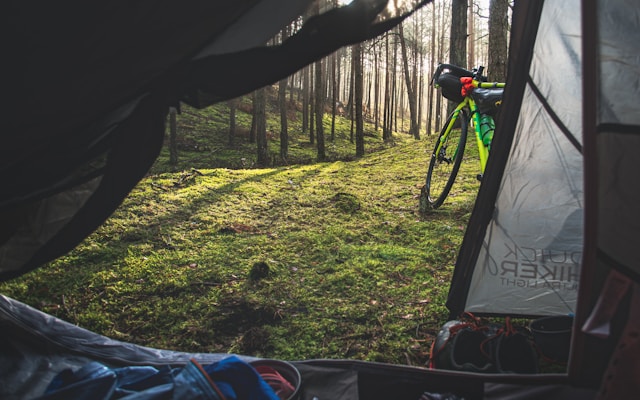
Kitting Out Your Mobile Home: Camping and Sleeping Gear
Lightweight tents used to be prohibitively expensive, but not so in 2025. Even just a few pounds of extra weight can make a big difference, so try to go as lightweight as your budget will go. For some destinations, a hammock system may be enough for sleeping.
For your sleeping bag, you need to check the weather. Compact sleeping bags tend to only be good for temperatures as low as 5°C, which is basically your average UK summer night. Remember to take a mat that provides both insulation and comfort.
Cooking systems can get too complicated, you want to save weight here. Go for the basics only, a lightweight stove, a compact pot set, and basic multi-purpose utensils.
Going wild camping? You will need a water filter/purification system. And don’t forget your collapsible water bottle. For your recharging, a compact power bank + solar panel combo is great.
Finally, remember to have a simple bike repair kit. Your smartphone should have all maps downloaded for offline use, as you may be going to places with a weak mobile signal.
The key is not in having the most expensive gear but investing in the equipment that suits your specific needs, budget, and experience level. Don’t go straight into the longer tours, start small. See what works for you and your group.
Just remember, veteran cyclists have completed tours you’ll probably never end up doing with just basic gear. Build from the essentials and go from there.


